

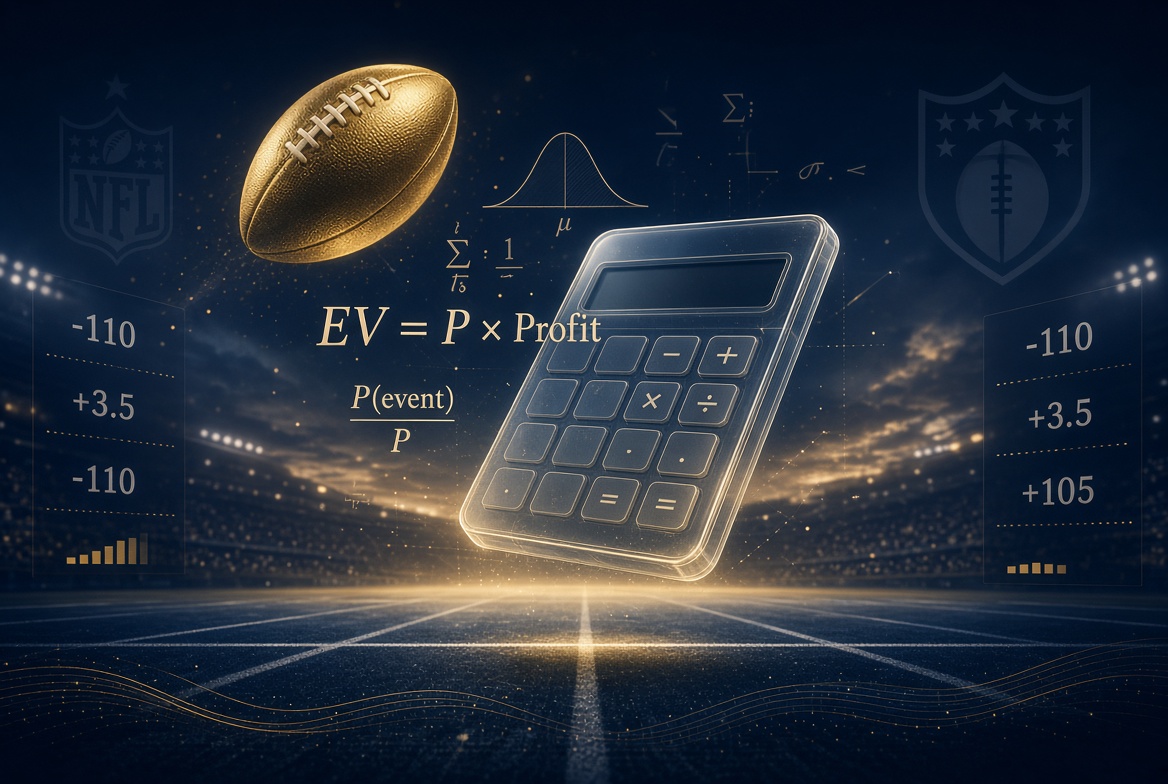
Learning how to calculate EV turns random football bets, as well as other sports, into calculated decisions. EV, or Expected Value, tells you the average amount you stand to gain or lose on a bet if you placed it many times under the same conditions. It does not guarantee a win on any single match. Instead, it shows whether the odds offer a long-term edge.

How To Calculate EV In Sports Betting: A Beginner’s Guide
Most new bettors focus only on who they think will win. That approach ignores the price. A favorite can still be a bad bet if the odds are too short. An underdog can be excellent if the odds are generous enough. When you know how to calculate EV, you stop chasing feelings and start comparing your estimate of the real chance against the bookmaker’s price.
Football markets make this skill especially useful. Games produce clear outcomes. You have a home win, away win, or a tie. Plus, there are goal markets and handicaps. You can apply the same simple math to any of them. This guide walks through the idea, the formula, and a full example so you can start using it on the next game day.
What Expected Value Actually Means
Before we look at how to calculate EV in sports betting, let’s talk about what expected value actually means. Expected Value measures the long-run average result of a bet. You calculate it by combining the odds with your own probability estimate. A positive EV means that if your probability is accurate, the bet will profit over hundreds of similar wagers. A negative EV means the sportsbook holds the advantage.
Think of it as a filter. You no longer ask only “who will win?”, you also ask “are the odds good enough for the chance I believe is true?” A team you rate at 55% to cover can still be a bad bet at -120. The same team becomes attractive at +100. The calculation forces that comparison every time.
Beginners sometimes assume any side they like has value. The formula corrects that habit quickly. It keeps you focused on price rather than preference.
Why Calculating EV Helps On NFL And College Slates
NFL and college football produce dozens of games each weekend. That volume lets a small edge compound if you stay disciplined. Most recreational bettors lose because they accept the opening number or chase public sides. When you calculate EV, you become selective. You bet only when the line offers a clear advantage, and you pass on everything else.
The same method works across markets. You can apply it to a -3.5 spread, a moneyline on a big underdog, or an over/under total. College games often show larger line differences between books, which can create more opportunities. NFL markets are tighter, so accuracy in your probability estimates matters even more. Over a full season, the difference shows up in your results. Positive-EV bets do not win every week. However, they win often enough, at good prices, to grow your bankroll.
The EV Sports Betting Formula
The basic formula for EV is easy to remember. EV equals win probability times profit if the win hits, minus loss probability times stake. It’s written like this: EV = (Win Probability x Profit if Win) – (Loss Probability X Stake).
“Profit if win” equals your stake multiplied by. Loss probability is 1 minus your win probability. You can also use a shorter version, which looks like this: EV per unit = (Win Probability X Decimal Odds) – 1.
A positive number is +EV. A negative number is -EV. Most bettors convert the result to a percentage of the stake so they can compare a $50 bet with a $200 bet on equal terms. American odds convert quickly. -110 is roughly 1.91 in decimal. A +150 is 2.50. Once the odds are in decimal format, the rest is simple arithmetic. A calculator or a phone app handles it in seconds.
Step-By-Step Process For Any Football Bet
First, convert the odds to decimal if needed. A lot of books have an option where you can just set your true probability that the bet wins. Use power ratings, recent form, injuries, weather, or whatever method you trust. Write the probability as a decimal. For example, 52% becomes 0.52.
Calculate the profit on a win. Then multiply that profit by your win probability. Multiply the stake by the loss probability. Subtract the second figure from the first. The result is your expected value in dollars. Divide by the stake to see the percentage edge. Don’t worry, I’ll show a live example here soon.
Only place the bet if the edge is clearly positive after you account for the sportsbook’s juice. Track every calculation so you can review your accuracy later.
NFL Point Spread Example
Let’s look at an example in the NFL. Suppose you believe the Kansas City Chiefs have a 56% chance to cover -2.5 against the Las Vegas Raiders. The sportsbook offers -110 on the Chiefs, and you plan to risk $100.
Decimal odds for -110 are approximately 1.91. Therefore, the profit if the bet wins is $91. Here’s what everything broken down looks like. Win contribution is .56 (your 56% chance belief – this is where you have to use some of your own knowledge) x $91 (the profit). That equals $50.96.
Your loss probability is 0.44 (100 minus your 56% chance belief = 44%. That places the loss contribution at 0.44 x $100. That equals $44. Therefore, your EV is $50.96=$44.00, which equals $6.96, or about +7%. Using the compact formula, it is 0.56 x 1.91 – 1 = +0.0696.
Now, check the same probability at a worse number. If the line is -3.5 at -110 but you rate the cover chance at only 52%, the EV drops to roughly -2%. Same team, different price, different decision. The math would tell you to pass.
College Football Moneyline Example
Now let’s look at a college football example. Imagine a Saturday night game where you rate an underdog at 38% to win outright. The book offers a +180 (2.8) number. The stake is just $50 on this one.
The profit if a win hits is $50 x (2.8 -1) = $90. Therefore, your win contribution is 0.38 (38% chance to win) X $90, which equals 34.20. Loss contribution is 0.62 x $50, which is $31.00. EV + $34.20 – $31.00, which is +$3.20, or a +6.4 percent.
That is a solid edge for a college underdog. If the same team was priced at +140, the EV would turn negative with the identical probability. Price decides value more than the name on the jersey.
Estimating Probability Without Overcomplicating It
It’s important to keep in mind, that the formula is only as good as the probability you feed it. Start simple. Look at recent margins, home/road splits, key injuries, and weather for outdoor games. Turn those factors into a rough percentage. Compare your number with the implied probability of the line to see if an edge exists.
More experienced bettors remove the juice from sharp closing lines and use the no-vig probability as a benchmark. You can do a basic version on two-way markets by converting both sides to implied probabilities, adding them, and dividing each by the total. The gap between that fair number and the price you see is your potential edge.
Record every estimate. After 50-100 bets, you will see which inputs produce the most accurate probabilities for NFL and college football.
Avoid These Mistakes
When you’re learning how to calculate EV, make sure you avoid some of the most common mistakes. The biggest error is treating the sportsbook’s implied probability that you feed it. That almost always produces a negative EV once the juice is included. Another common mistake is ignoring the size of the edge. A +1 percent EV bet is barely worth the variance. Many successful bettors wait for a certain threshold, such as +3% or better.
Chasing huge underdogs with massive positive EV numbers also creates problems. A +15% edge on a 25% probability outcome will still lose most of the time in the short run. Bankroll management must travel with the calculation. Finally, never adjust your probability just to force a bet. If the numbers do not support value, then it’s time to move to the next game.
Using This Every Week
Pick a handful of markets you follow closely, whether that would be NFL spreads, college totals, or moneylines. Calculate EV before you bet. Keep a simple log of the game, your probability, the odds, the stake, and the resulting EV. After a month, review which positive-EV bets performed best.
You can check your math with free online EV calculators while you learn. I did 100 mock bets to see how accurate my calculations were. Since you’re adding in your projected win probability, it’s not perfect, and everybody’s EV can be different. Once your process feels automatic, expand to more games. The goal is not to bet every edge. It is to bet only when the edge is clear and the stake fits your bankroll.
Calculating EV isn’t going to automatically make every single Sunday profitable. It will give you a consistent way to evaluate every NFL and college football bet you consider. Start with this week’s slate, run the numbers, and let the math decide. However, remember to take it cautiously until you learn more.
Hopefully this all made sense and can help you get started! It’s not a perfect science. However, with some practice, it can turn random hopes into a more calculated edge.