

Pai Gow Poker survives on the floor because it feels harmless. Hands take a long time, and roughly four deals in ten push. Nobody is yelling at a dice crew. The calm setting is the product. It is also a trap. A game that resolves slowly can still grind a stack if you sit on the wrong ticket long enough.
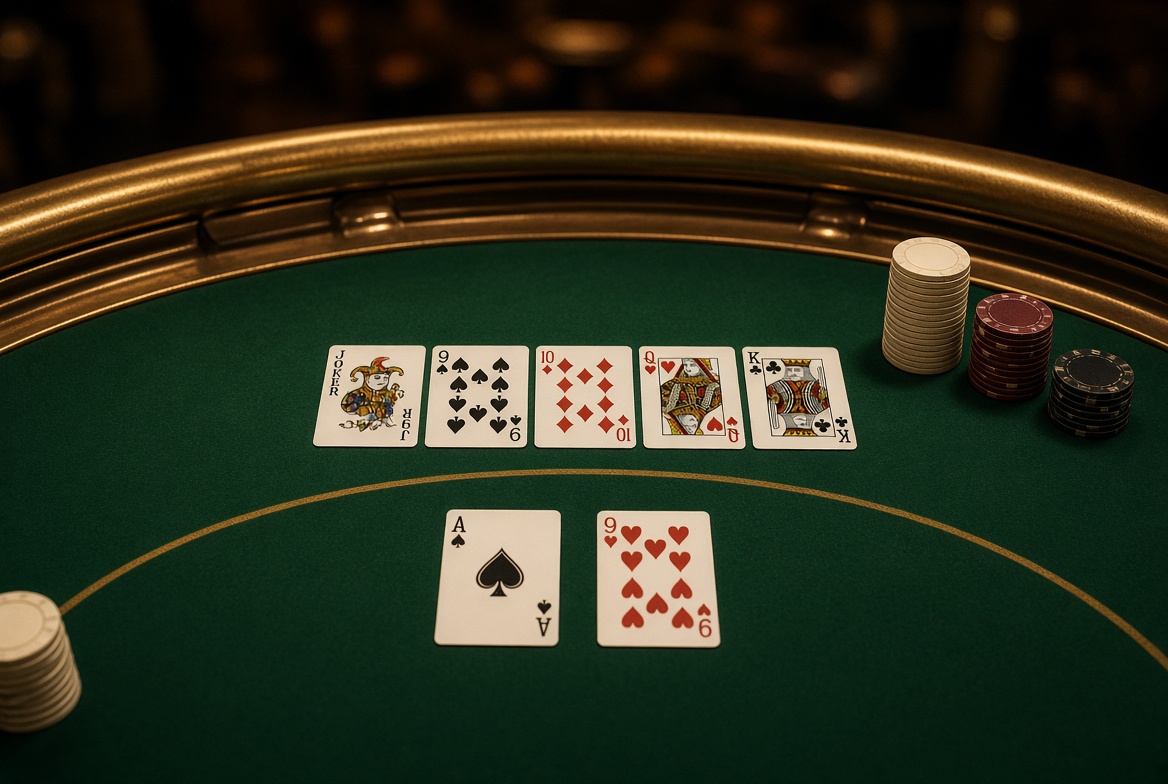
The game itself is simple to describe and easy to misprice. Seven cards and two hands. That’s the gist of it. The five-card high must beat the two-card low. The joker is an Ace unless it is filling a straight or a flush. Copies go to the banker, and wins pay even money minus five percent. The only decisions that move the number are how you set, whether you take the banker seat, and whether you touch Fortune/Envy. Ignore the pace, and shop these three things.

Pai Gow Poker Shopping: House Way Vs. Setting Your Own Hands
The house edge is baked into the rules and the commission, not into your sequences of wins and losses. Doubling after a loss doesn’t change the long-run cost of each hand. Pai Gow Poker uses a 53-card deck. It’s a standard deck plus one joker. Everyone gets seven cards and splits them into a five-card high hand and a two-card low hand.
The high hand must outrank the low hand. Break that rule and the hand is fouled, which is an automatic loss. Each of your hands is compared with the dealer’s matching hand. Win both, and you get even money minus a five percent commission. Win one and lose one, and the bet pushes. Lose both, and the chip is gone. Exact ties, called copies, go to the banker.
That copy rule is the first hidden price. The commission is the second. Together they are why the game is not even, even though it feels like it. About 40.5% of hands push. That keeps a session looking stable. It doesn’t change the tax on the hands that resolve.
House way versus setting it yourself is a small number. Banking versus sitting as a regular player is a big number.Fortune/Envy is a different product altogether on the same felt.
The Ranked Card
The best version of Pai Gow Poker is the main bet with a clean set of rules. With the dealer banking and a standard five percent commission, the house-way setting odds cost about 2.72% expected loss per hand. Optimal settings trim this slightly. This isn’t blackjack or full-pay video poker. However, it is still one of the cheaper tickets in the pit if the side bet stays off the table.
Second is the banker option when a live table actually offers it. Banking flips the copy rule in your favor. Under house-way rules, the player-banker edge is about .25% against you. The swing from sitting as a regular player to banking is about 2.47%. That’s the real way to shop this. House-way rules versus set it yourself is a fifth of a percent. The banker seat is almost two and a half.
Third, and still playable, is asking the dealer to set your cards the house way. You give that .21% against a theoretically perfect strategy that almost nobody plays. You also stop fouling hands, which is the expensive amateur mistake.
The worst ticket at the same table is playing the Fortune option, plus the Envy bonus that rides with it. A common paytable carries about a 7.77% house edge before Envy. A full table can drag that down. A short table or an online seat leaves you near 8%. That’s a second game with a worse number. We’re sports gamblers. We know to shop around and not fall for that trap!
Why The Joker And The “High Must Beat Low” Rule Matter
The Joker is not fully wild. It is an Ace, or it fills a straight, a flush, a straight flush, or a royal flush. It does not turn a pair of sevens into three of a kind just because you want it to. Treat it as an Ace unless it actually finishes a made hand as described above.
The high-must-beat-low rule is the other non-negotiable. A pair in the two-card hand is strong. It is not allowed to outrank the five-card hand, though. Players who “set for the win” and ignore that constraint do not get a big double. They get a foul. The house-way exists partly to stop that.
Casino charts vary, so ask the dealer which one they use if it’s not posted. However, the principle will always be the same. With no pair, the second- and third-highest cards go low. With one pair, the pair stays high, and the two best leftovers go low. Two pair is the spot that changes results. Low pairs usually stay together, high pairs split, and an Ace in the leftovers is often why both pairs stay in the five-card hand. Three-of-a-kind sends the highest pair low. Trips stay high, except if you split three Aces. A full house is trips high and a pair low. You get the idea.
Setting it yourself is worth the extra .21% if you know the exceptions. If you cannot recite the two-pair and joker spots, you are not beating the house anyways. At that point, you’re just guessing.
The Banker Seat
At most live tables, the right to bank rotates, or at least can be requested. When you bank, the other players are betting against you. The house still takes five percent on net wins, and copies now belong to you instead of the dealer. That is why the math moves by about 2.47% when you take the banker seat.
Banking isn’t free money. That’d be too easy. You have to cover the other bets, or as much of them as the table will let you cover. You need a bankroll that can absorb a table full of winners on the same deal. The dealer keeps the bank more often than the posted rotation suggests. The house wants a bigger stake than you want in the middle.
When the banker option is real, take your turn. When it is theater, treat the game as a 2.5% net loss product and size the session like one. Commission-free versions do exist in some markets, especially in Washington state, and they change the price. Read the felt before you assume the 5% is in play.
Skip Fortune And Envy
Fortune looks like value because the top end pays thousands-to-one. Natural seven-card straight flush, five Aces, and royal flushes fall into these. They are lottery numbers printed next to a poker table. The common payouts still pay 2-to-1 for a straight, 3-to-1 for trips, 4-to-1 for a flush, and 5-to-1 for a full house. It’s not a gift. It’s hoping a same-game parlay hits.
Envy is the marketing hook. Put five dollars or more on Fortune, and you get a fixed extra payout if another player makes four of a kind or better. The extra return is real. However, it also requires other people to win and to have perfect cards.
Shopping Pai Gow Poker Like A Sportsbook Line
To shop Pai Gow Poker like a sportsbook, start with the commission and banker rule. A five percent win tax plus dealer-as-banker is the standard price. No-commission rules, or a rotation you can actually take, change the ticket.
Then decide how you are going to set your hands. The house way is the floor. Setting your own hands is only an upgrade if you know the exceptions and the game well. If you don’t, you are not playing better than the house. Instead, you are introducing error.
Next, you should inspect the speed of the game. Live Pai Gow Poker is slow. You’ll often only play 25 to 30 hands an hour. A 2.5% expected loss game dealt slowly can cost less per hour than a cheaper game dealt fast. That matters for a session budget. Online versions tend to flip that. The edge stays the same, but the hands per hour tends to go up since it is online and not relying on the speed of a true dealer.
Leave Fortune and envy alone unless you have extra money. The bonus is just marketing. You’re not getting a raised payout on the main bet. You’re just funding a spike.
The favorite is the main bet with house way or better ,and the banker seat whenever the room will actually give it to you. That pairing is the only way Pai Gow gets close to a flat game. We’d all rather take a -110 Moneyline play over a +500 parlay. Well, maybe we wouldn’t. However, we should when it comes to bankroll management.