

Multi-hand video poker lets you play several hands at once from the same initial deal. Many players assume more hands automatically improve results because they see more action. However, the opposite can happen if you ignore variance and bankroll requirements. You need to understand how the format changes your exposure before you decide whether it helps or hurts your long-term results.

Multi-Hand Video Poker: Does Playing More Hands Improve or Hurt Your Results?
How Multi-Hand Video Poker Works
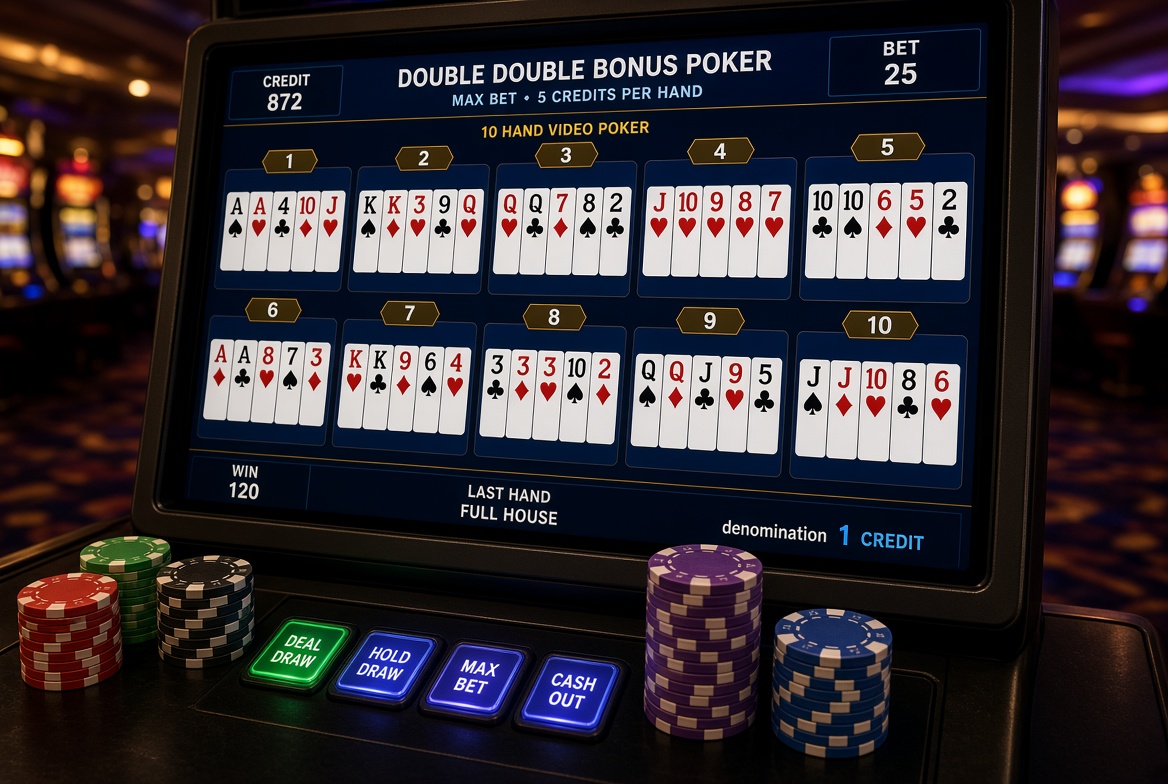
In multi-hand video poker, you receive one set of five cardsa nd then choose which cards to hold. The game then deals the remaining cards separately for each hand. Most versions offer 3, 5, 10, 25, or even 100 hands. You pay the full bet amount for every hand, so a 10-hand game costs ten times as much per deal as a single-hand game.
The hold decisions stay identical across all hands because you make them before the final cards are dealt. Therefore, optimal strategy does not change from the single-hand version of the same game. The difference lies only in the number of outcomes you experience from each division. Some machines also offer progressive jackpots on multi-hand formats. However, the base paytable usually stays the same as the single-hand game.
Players often like the format because it feels faster and produces more frequent small wins. Meanwhile, the total amount wagered rises quickly, which changes both the speed of bankroll movement and the size of swings.
The Math Of Playing Multiple Hands
Each hand is an independent event after you lock in your holds. The expected return percentage stays exactly the same whether you play one hand or fifty. A 99.5% return game remains a 99.5% return game per hand. However, the variance scales with the number of hands because you are exposing more money to the same set of probabilities.
For example, a single-hand session of 100 deals at $1 per hand risks $100. The same 100 deals on a 10-hand game at $1 per hand risk $1,000. Your expected loss stays proportional, but the range of possible outcomes widens. You can finish a short session much further ahead or much further behind than you would on a single-hand machine.
Additionally, the higher volume means you reach the long-run return faster in terms of hands played, yet you also burn through money faster if the results run cold. The math favors neither format by itself. Your results improve only when the increased volume matches a bankroll large enough to absorb the larger swings.
Bankroll Requirements And Variance
Multi-hand video poker demands a larger session bankroll than single-hand play at the same per-hand stake. A common guideline is to multiply your normal single-hand bankroll by the number of hands.
If you normally bring 200 times your bet size for a single-hand session, a 10-hand game needs roughly 2,000 times the per-hand bet. Otherwise, you face a high chance of busting during normal variance.
You also experience bigger downswings in dollar terms. A cold stretch that costs you $40 on a single-hand machine can cost $400 on a 10-hand machine in the same number of deals. Therefore, many players reduce their per-hand bet when they switch to multi-hand formats. Playing 10 hands at $0.25 often creates a more manageable risk profile than 10 hands at $1.
Track your results in both total dollars and dollars per hand. This separation shows whether the extra hands are accelerating the same expected loss or whether something else is affecting your outcomes. That way, you know if you need to adjust your stake size.
Strategy And Decision Quality
Optimal holds remain the same, yet decision quality can drop when you play many hands. The screen fills with more cards, and the pace increases. Some players rush their holds or second-guess close decisions under the higher pressure. Meanwhile, fatigue sets in faster because each deal costs more money and feels more consequential.
Stick to games and paytables you already know well. Switching to multi-hand on an unfamiliar paytable raises the chance of strategy errors that compound across every hand. Additionally, avoid raising the number of hands mid-session after the win. The larger exposure can turn a small profit into a large loss on the next cold run.
Set a max number of hands based on your current bankroll rather than the highest option the machine offers. Most recreational players stay between 3 and 10 hands. Higher counts work better for players who have substantial bankrolls and proven discipline within the game.
When More Hands Help And When They Hurt
More hands help when you want faster feedback on your strategy, and you already size your bets correctly. You see more outcomes per hour, which can confirm whether your holds are working as expected. The format also suits short sessions if you lower the per-hand stake so the total risk stays within your normal limits.
More hands hurt when you keep the same per-hand bet and simply multiply your exposure. In that case, you accelerate both wins and losses. However, the losses arrive in larger chunks that not a lot of people can absorb. The higher cost per deal can push players into poor decisions or longer sessions chasing losses.
Test the format with a reduced stake for at least 20 sessions before you increase either the bet size or the number of hands. Compare your results per hand against your single-hand baseline. When the numbers stay consistent and your bankroll remains stable, multi-hand poker can fit into your routine. Otherwise, the extra hands mainly increase risk without improving your underlying results.